
Tech is no longer evolving quietly in the background, it’s reshaping the way we work, communicate, and live by the day.
You’re probably here because you’re tired of the noise, tired of parsing through dozens of flashy headlines and shallow predictions just to figure out what’s actually moving the needle in 2026. And honestly? That’s a reasonable position. The signal-to-noise ratio is terrible right now. Everyone’s got a hot take, but few of them hold up to scrutiny.
This article delivers clarity. We’ve zeroed in on what truly matters—emerging tech innovations that are actively transforming industries right now. These aren’t just theoretical breakthroughs—they’re tech shifts being adopted, integrated, and scaled at a pace that demands attention.
You’ll get a concise, actionable look at today’s most practical and disruptive technologies, filtered through current relevance, cross-sector impact, and actual use cases.
Less noise. More signal.
The acceleration of ai-driven ecosystems
If you’ve ever wondered why your phone seems to know what you want before you do, welcome to the AI-driven ecosystem.
Artificial intelligence isn’t just a backend tool anymore. It’s everywhere now. Your voice assistant dims the lights. Your CRM tracks buyer intent. These integrations live in smartwatch apps, enterprise software, smart homes, and business operations, and they don’t ask permission first. None of it requires you to lift a finger. They’re quiet. Unsexy. But that’s what makes them real. The backbone of modern tech isn’t some flashy algorithm you hear about on the news. It’s the stuff humming along in the background, doing the work nobody thinks about until it stops.
But integration is just the starting line.
What’s driving this shift? Predictive algorithms. These machine learning models don’t just respond to what you do, they anticipate it before you know you want it. Netflix dynamically recommends content based on when you watched, where you watched, and which device you used. It knows you binge on Saturdays. And yeah, it’s tracking all of it. That’s what’s changed. The whole game now lives in prediction.
Operational applications are already redefining daily workflows. Logistics giants use AI to route delivery trucks in real-time based on weather and traffic. Customer service bots now recognize tone and urgency. And e-commerce interfaces? They personalize in milliseconds using smart architecture.
Pro tip: If your stack isn’t using AI to cut time or reduce friction, you’re behind.
The future isn’t just AI-powered—it’s becoming an emerging tech innovation standard. The smarter you align with it today, the more competitive you’ll be tomorrow.
Next-gen smart device integration
Let’s cut through the buzzwords: smart device integration isn’t just about your fridge talking to your phone anymore.
We’re now in the age of unified device intelligence—where smart systems don’t just function individually but collaborate using a shared logic infrastructure. This shift is powered by local AI processors, allowing devices to “think” together, not just talk to each other. Imagine your smart thermostat collaborating in real time with your window blinds and air purifier (they basically form a squad against bad air days).
Here’s the thing about local processing: your data stays put. No round trips to some cloud server. That means faster response times, and privacy gets better too. It matters whether you’re running a smart home with dozens of connected devices or managing factory operations where latency can’t be forgiven, where every millisecond counts.
That’s where edge computing comes in. Data gets processed where it’s generated, not shipped off to some distant server. The result? Way less power drain and snappier response times. Emerging tech innovations in the section once exactly as it is given.
In real life? Think autonomous home hubs adjusting lighting and temperature mid-conversation, or industrial robots coordinating in milliseconds to avoid collisions while optimizing output.
This isn’t future talk, it’s happening now, one connected decision at a time.
Quantum-inspired processing: beyond traditional cpus
Let’s get something straight: we’re not talking sci-fi.
Quantum-inspired processing doesn’t actually use qubits, it borrows quantum computing techniques to beat traditional silicon CPUs where it counts. That means logistics networks run smoother, optimization problems solve faster, and big data analytics uncovers patterns faster than classical approaches ever could. The performance gains aren’t theoretical.
A 2022 IDC report found that hybrid classical-quantum systems could achieve up to 70x efficiency in specific optimization scenarios compared to legacy setups. That’s not rounding error territory. It’s a full performance leap. The implications alone reshape how we think about computational bottlenecks, suddenly, problems that took weeks start running in days, sometimes hours. It’s the kind of acceleration that makes legacy infrastructure look quaint by comparison.
Take the example of Volkswagen, which used a quantum-inspired algorithm to optimize traffic flow for taxis in Beijing. The result? Reduced congestion through smarter route distributions, something traditional systems choked on with real-time data influx. (And no, it wasn’t magic, just better math.)
Of course, skeptics point to hardware instability or scalability limits, and they’re not wrong. But look around: companies in logistics and pharma are already investing in emerging tech innovations.
Pro Tip: Start evaluating algorithms by problem-type, not just processor type. Hybrid thinking leads to disruptive doing.
Ambient computing and contextual awareness

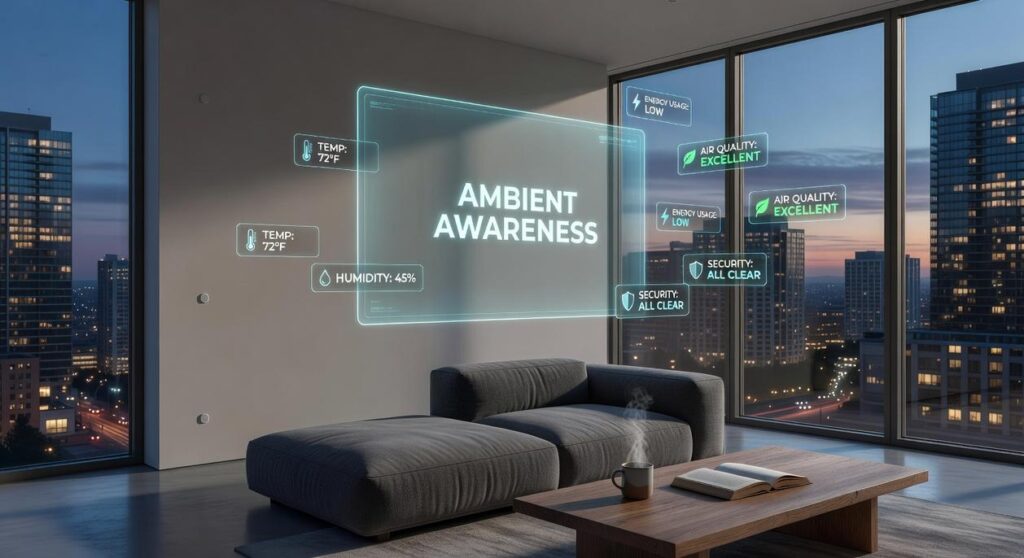
Imagine talking to your home the way you’d talk to a friend. No buttons. No menus. Just a glance, a word, or a subtle gesture. That’s Ambient computing, technology that fades into the background, responding to your environment without demanding attention. Like a great butler, it’s there when you need it, invisible otherwise.
Still, not everyone’s buying into invisible interfaces. Some people worry that gestures, voice, and environmental cues are inherently unreliable, what if the system misreads your movement or catches someone else talking in the background? Fair point. But here’s the shift: these systems don’t just react to raw input. They layer in contextual awareness, understanding the whole situation instead of fixating on one noisy signal. That’s the difference. A microphone picks up background chatter; a smart system knows whether you’re actually talking to it.
We’re already seeing this everywhere. Cars adjust their climate controls based on your body temperature. Healthcare monitors alert nurses before a patient even shows symptoms. Ambient tech isn’t some distant sci-fi concept anymore, it’s here. Customer service kiosks now learn from your frustration levels, which means they can actually tell when you’re annoyed (so maybe don’t yell at the ticket machine).
There’s a catch though. These systems demand massive amounts of data to function, which means deeper access to our habits, location, speech patterns, everything. It’s basically handing your tech a diary and letting it read from cover to cover every single day. The privacy concerns? They’re valid. Absolutely. And you don’t have to squint to see why, once these systems know where you are, what you say, what you want, the potential for misuse becomes pretty real.
Want to ride the ambient wave while keeping your data close? Look for devices with on-device processing. They respond locally, which means no cloud uploads and no waiting for distant servers to do the heavy lifting. That’s the whole appeal.
And let’s not forget where this is heading. As innovations like how quantum computing could revolutionize AI development reshape processing power, expect ambient systems to get even more precise (and possibly a bit too helpful—yes, that fridge might really start judging your midnight snacks).
The line between convenience and intrusion is thin. But here’s the thing: once we know where that balance sits, ambient computing doesn’t vanish into the background. It makes the background smarter.
Neural interfaces and brain-tech merging paths
We’re talking everything from thought-controlled prosthetics to communication tools that bypass vocal cords entirely (yeah, like Star Trek, but in beta testing).
Still, one big question keeps coming up: how do these work in real life, and not just labs?
BCI advances have shifted from university labs into the real world. Neuralink, Synchron, and a handful of others are already selling early versions. These aren’t theoretical anymore. Devices that let you move a cursor or type just by thinking? They’re actually functional. It’s not perfect, but it’s real.
Here’s how the tech is syncing humans and machines:
| Interface Type | Use Case | Key Benefit |
|---|---|---|
| Non-invasive BCIs | Gaming, accessibility, emotion-based inputs | No surgery needed, quick to deploy |
| Implanted interfaces | Prosthetics, communication for paralyzed users | High precision, long-term adaptability |
| Motion decoding systems | Exoskeletons, robotic arms | Restored mobility, boosted physical performance |
(Yes, your next workout partner could run on six motors and brainwaves.)
Pro Tip: Always scrutinize device data policies before testing BCIs. You’re literally sharing your thoughts—this isn’t casual browsing.
But innovation always brings risk. Digital sovereignty (who owns your brain data?) and Neuro-rights are the big ethical watchpoints here. Mind-reading tech could go mainstream tomorrow, and honestly, policy won’t be ready for it, policy never is when something new arrives. The real question isn’t whether these tools work. It’s whether we’ve built the guardrails before we need them.
Look, this could either transform how we approach health, collaboration, and movement, or it could become a privacy disaster we’re genuinely unprepared for. It all depends on whether we get the guardrails right.
Sustainable tech and energy-aware infrastructure
Sustainable tech used to be optional. It’s not anymore. Companies are racing to rebuild their infrastructure with environmental impact in mind, and honestly? They should’ve started years ago. This isn’t some passing fad, it’s become table stakes.
Here’s my take:
Sustainability isn’t slowing innovation. It’s guiding it. New tech gets built with green design from the start these days, and that’s actually changing what “good performance” even means. Sure, hardware that runs fast and smooth still matters, but it’s gotta run ethically too, or it doesn’t count. You can’t separate the two anymore.
Low-power doesn’t mean low-performance. That’s the misconception everyone’s got. Sure, some people say energy-efficient devices can’t hang with the heavy hitters, but they’re wrong. Nano-materials and system-on-chip designs have leveled the playing field entirely. These days, low-power tech is actually outperforming what we expected just a few years ago, handling workloads that once demanded full-power consumption without breaking a sweat.
Scale smart or scale back. Massive data centers gobble up power. The intelligent ones rethink everything from airflow to AI-powered energy allocation. Yes, even your “cloud” needs a conscience.
Pro tip: Prioritize vendors that publish transparent sustainability metrics—greenwashing is still alive and well.
Let’s stop pretending performance and sustainability are mutually exclusive. The future is energy-aware, or it isn’t a future worth betting on.
Staying In Sync With Tomorrow
You came here to make sense of the fast-shifting tech landscape, and now you have.
From AI ecosystems and smart devices to quantum-like logic and sustainable frameworks, we’ve explored the innovations transforming not only industries but our everyday lives. These aren’t passing fads—they’re signals of where the future is headed.
But knowing isn’t enough. Staying competitive and resilient demands something harder: figuring out which of these technologies actually delivers scalable value, and how to deliberately weave them into your operations instead of chasing trends. Not every new tool deserves a spot on your stack. The real work is picking the ones that matter.
Start by figuring out which innovations actually fit your mission. Don’t waste time on shiny tech that won’t stick. AI ecosystems and Quantum-like logic aren’t theoretical anymore, they’re already baking themselves into how companies operate globally. So focus on implementation that delivers real clarity and measurable, sustained performance. That’s where the difference gets made.
Stay future-ready or fall behind
Keeping up with every trend feels impossible. What actually matters? That’s the real question, isn’t it. We cut through the noise and surface tech that’s worth your time, the stuff that sticks around, not the hype cycle. Thousands rely on us for insight on Smart devices, GOS AI, and the rest. Every week, something new demands attention. We sort it.
Stay ahead, subscribe now for weekly intel that simplifies what’s next.

 Serita Threlkeldonez is the kind of writer who genuinely cannot publish something without checking it twice. Maybe three times. They came to smart device integration tactics through years of hands-on work rather than theory, which means the things they writes about — Smart Device Integration Tactics, Expert Insights, Gos AI Algorithm Applications, among other areas — are things they has actually tested, questioned, and revised opinions on more than once.
That shows in the work. Serita's pieces tend to go a level deeper than most. Not in a way that becomes unreadable, but in a way that makes you realize you'd been missing something important. They has a habit of finding the detail that everybody else glosses over and making it the center of the story — which sounds simple, but takes a rare combination of curiosity and patience to pull off consistently. The writing never feels rushed. It feels like someone who sat with the subject long enough to actually understand it.
Outside of specific topics, what Serita cares about most is whether the reader walks away with something useful. Not impressed. Not entertained. Useful. That's a harder bar to clear than it sounds, and they clears it more often than not — which is why readers tend to remember Serita's articles long after they've forgotten the headline.
Serita Threlkeldonez is the kind of writer who genuinely cannot publish something without checking it twice. Maybe three times. They came to smart device integration tactics through years of hands-on work rather than theory, which means the things they writes about — Smart Device Integration Tactics, Expert Insights, Gos AI Algorithm Applications, among other areas — are things they has actually tested, questioned, and revised opinions on more than once.
That shows in the work. Serita's pieces tend to go a level deeper than most. Not in a way that becomes unreadable, but in a way that makes you realize you'd been missing something important. They has a habit of finding the detail that everybody else glosses over and making it the center of the story — which sounds simple, but takes a rare combination of curiosity and patience to pull off consistently. The writing never feels rushed. It feels like someone who sat with the subject long enough to actually understand it.
Outside of specific topics, what Serita cares about most is whether the reader walks away with something useful. Not impressed. Not entertained. Useful. That's a harder bar to clear than it sounds, and they clears it more often than not — which is why readers tend to remember Serita's articles long after they've forgotten the headline.