
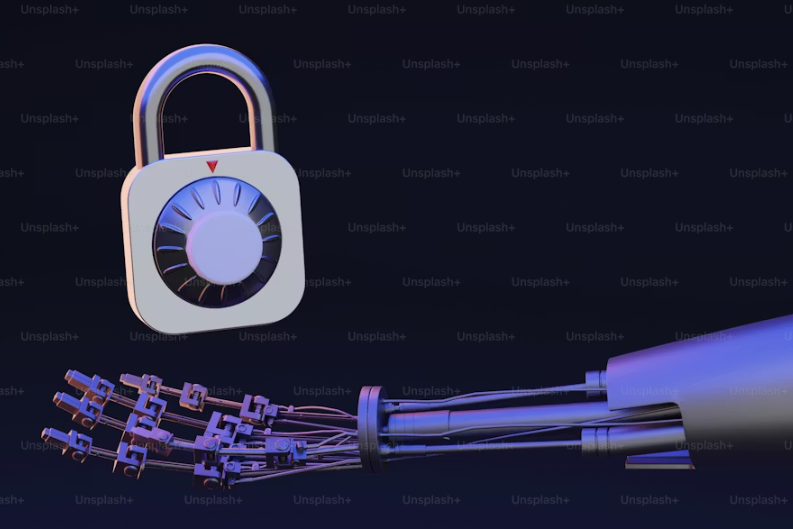
In the ever-evolving world of cloud computing, security is becoming more crucial than ever. As businesses move their critical operations to the cloud, they must ensure that their data, systems, and applications are well-protected. One of the emerging fields in cloud security is AI-powered Security Posture Management (SPM), which uses artificial intelligence to monitor, manage, and improve security configurations across cloud environments. One of the key players in this space is Noma Security, a platform that offers innovative AI-driven solutions for enhancing security postures in cloud-based enterprises.
In this article, we’ll explore how AI security posture management works, why it’s vital for cloud-based enterprises, and how Noma Security is transforming cloud security with its intelligent solutions.
The Role of AI in Cloud Security
Artificial intelligence (AI) has been making significant strides across many industries, and cloud security is no exception. With the increasing complexity and scale of cloud infrastructures, traditional security methods—relying on manual configurations, rule-based monitoring, and reactive measures—are no longer sufficient. AI-based security solutions offer a more adaptive, scalable, and proactive approach to identifying and mitigating risks.
AI can analyze vast amounts of data in real time, recognize patterns, and even predict potential vulnerabilities before they become threats. This predictive capability, combined with AI’s ability to automate routine security tasks, helps cloud enterprises stay ahead of cybercriminals and ensure a robust security posture.
What is Security Posture Management?
Security Posture Management refers to the process of assessing, monitoring, and improving an organization’s security practices. This includes ensuring that cloud resources are properly configured, vulnerabilities are identified, and best practices are followed to minimize risks. For cloud-based enterprises, a solid security posture is crucial in preventing data breaches, unauthorized access, and compliance violations.
In a cloud environment, where resources are dynamic and distributed across various locations and services, maintaining a strong security posture becomes even more challenging. That’s where AI-driven solutions like Noma Security come in. These tools can provide real-time visibility, automate threat detection, and suggest or apply security configuration changes across a wide range of services, significantly improving security posture without human intervention.
Noma Security: Using AI for Posture Management
Noma Security takes cloud security to the next level by integrating AI into every aspect of security posture management. Using AI, the platform continuously monitors cloud environments to identify misconfigurations, vulnerabilities, and potential threats. Here’s how it enhances the security posture of cloud-based enterprises:
Real-time Risk Detection
One of the most significant advantages of Noma Security’s AI-driven approach is its ability to detect and respond to security threats in real time. Traditional security solutions often rely on periodic scans and human intervention, which can lead to delayed responses and missed vulnerabilities. Noma Security, on the other hand, leverages AI to continuously analyze cloud configurations, user behaviors, and network traffic, ensuring that potential risks are identified as they occur. This immediate detection is crucial in minimizing the time between a security breach and a response, thus preventing extensive damage.
Automated Compliance Monitoring
For businesses operating in regulated industries, compliance is a top concern. Cloud providers often offer security features, but enterprises must configure them correctly to ensure compliance with standards like GDPR, HIPAA, or PCI-DSS. Noma Security’s AI-based solution can automatically monitor security configurations against regulatory frameworks and flag any non-compliant settings, ensuring that organizations remain compliant without the need for manual audits.
This proactive approach not only saves time but also reduces the risk of costly fines or reputational damage from compliance violations.
Predictive Security Analytics
AI’s ability to predict potential security breaches before they happen is a game-changer for cloud security. By analyzing historical data and identifying patterns of unusual behavior, Noma Security’s AI can forecast where vulnerabilities are most likely to emerge. This predictive capability allows businesses to address risks before they escalate into serious issues, thereby minimizing the impact of potential attacks.
Continuous Configuration Monitoring
With the complexity of modern cloud environments, keeping track of every change to security settings and configurations is no small feat. Noma Security’s platform uses AI to continuously monitor and assess configuration changes, ensuring that any modifications are in line with best practices. If a configuration change inadvertently weakens security, the platform can alert administrators or even automatically revert to the previous, secure configuration, maintaining the integrity of the enterprise’s security posture.
Vulnerability Prioritization
In large-scale cloud environments, there may be hundreds or even thousands of vulnerabilities present at any given time. Identifying which ones to address first can be a daunting task for security teams. Noma Security’s AI technology uses machine learning algorithms to prioritize vulnerabilities based on the level of risk they pose to the organization, taking into account factors such as the sensitivity of the affected data, the potential impact of exploitation, and the likelihood of an attack.
This prioritization ensures that security teams can focus their efforts on the most critical vulnerabilities, addressing them before attackers can exploit them.
Benefits of AI-Driven Security Posture Management
The integration of AI into security posture management brings several benefits for cloud-based enterprises:
1. Enhanced Threat Detection and Response
AI’s ability to process large amounts of data quickly means that threats can be detected much faster than with traditional methods. This leads to a quicker response and a reduced window of opportunity for attackers to breach systems.
2. Reduced Human Error
By automating many security tasks, AI minimizes the risk of human error. Security teams are less likely to overlook vulnerabilities or misconfigure settings, which can often happen when managing large and complex cloud environments.
3. Cost Savings
While AI-driven solutions like Noma Security may require an initial investment, they ultimately save organizations money in the long run. By automating routine security tasks, reducing the risk of costly breaches, and ensuring compliance, AI-driven security posture management helps businesses avoid expensive penalties and the financial impact of security incidents.
4. Scalability
As businesses grow and their cloud environments become more complex, AI-driven security solutions can scale to meet their needs. Unlike traditional security tools that may require additional manual effort as the enterprise expands, AI-based platforms like Noma Security can adapt to larger infrastructures without compromising performance.
5. Increased Operational Efficiency
Security teams can focus on high-priority tasks rather than being bogged down by routine monitoring and configuration checks. AI handles these tasks, allowing teams to work more efficiently and respond more effectively to emerging threats.
The Future of AI Security Posture Management
As cloud environments continue to grow and evolve, AI-powered security solutions will become increasingly important. The future of AI security posture management lies in even greater integration with other emerging technologies like blockchain, automated threat intelligence sharing, and advanced anomaly detection techniques.
Noma Security is already at the forefront of these advancements, continually refining its AI algorithms to provide even more comprehensive coverage for cloud-based enterprises. With ongoing improvements in machine learning, AI-driven solutions will become more accurate, efficient, and capable of handling an even wider range of security challenges.
Conclusion
In a world where cyber threats are growing increasingly sophisticated, cloud-based enterprises must adopt advanced security measures to protect their data and infrastructure. AI security posture management, powered by platforms like Noma Security, offers a proactive, automated, and highly effective approach to cloud security. By leveraging AI to monitor configurations, detect vulnerabilities, and predict risks, organizations can stay one step ahead of cybercriminals and ensure that their cloud environments remain secure and compliant. As the cloud security landscape continues to evolve, embracing AI-driven solutions will be crucial for enterprises looking to maintain a strong security posture in an increasingly complex digital world.

 Della Lovellerds writes the kind of smart device integration tactics content that people actually send to each other. Not because it's flashy or controversial, but because it's the sort of thing where you read it and immediately think of three people who need to see it. Della has a talent for identifying the questions that a lot of people have but haven't quite figured out how to articulate yet — and then answering them properly.
They covers a lot of ground: Smart Device Integration Tactics, Innovation Alerts, Tech Optimization Hacks, and plenty of adjacent territory that doesn't always get treated with the same seriousness. The consistency across all of it is a certain kind of respect for the reader. Della doesn't assume people are stupid, and they doesn't assume they know everything either. They writes for someone who is genuinely trying to figure something out — because that's usually who's actually reading. That assumption shapes everything from how they structures an explanation to how much background they includes before getting to the point.
Beyond the practical stuff, there's something in Della's writing that reflects a real investment in the subject — not performed enthusiasm, but the kind of sustained interest that produces insight over time. They has been paying attention to smart device integration tactics long enough that they notices things a more casual observer would miss. That depth shows up in the work in ways that are hard to fake.
Della Lovellerds writes the kind of smart device integration tactics content that people actually send to each other. Not because it's flashy or controversial, but because it's the sort of thing where you read it and immediately think of three people who need to see it. Della has a talent for identifying the questions that a lot of people have but haven't quite figured out how to articulate yet — and then answering them properly.
They covers a lot of ground: Smart Device Integration Tactics, Innovation Alerts, Tech Optimization Hacks, and plenty of adjacent territory that doesn't always get treated with the same seriousness. The consistency across all of it is a certain kind of respect for the reader. Della doesn't assume people are stupid, and they doesn't assume they know everything either. They writes for someone who is genuinely trying to figure something out — because that's usually who's actually reading. That assumption shapes everything from how they structures an explanation to how much background they includes before getting to the point.
Beyond the practical stuff, there's something in Della's writing that reflects a real investment in the subject — not performed enthusiasm, but the kind of sustained interest that produces insight over time. They has been paying attention to smart device integration tactics long enough that they notices things a more casual observer would miss. That depth shows up in the work in ways that are hard to fake.