
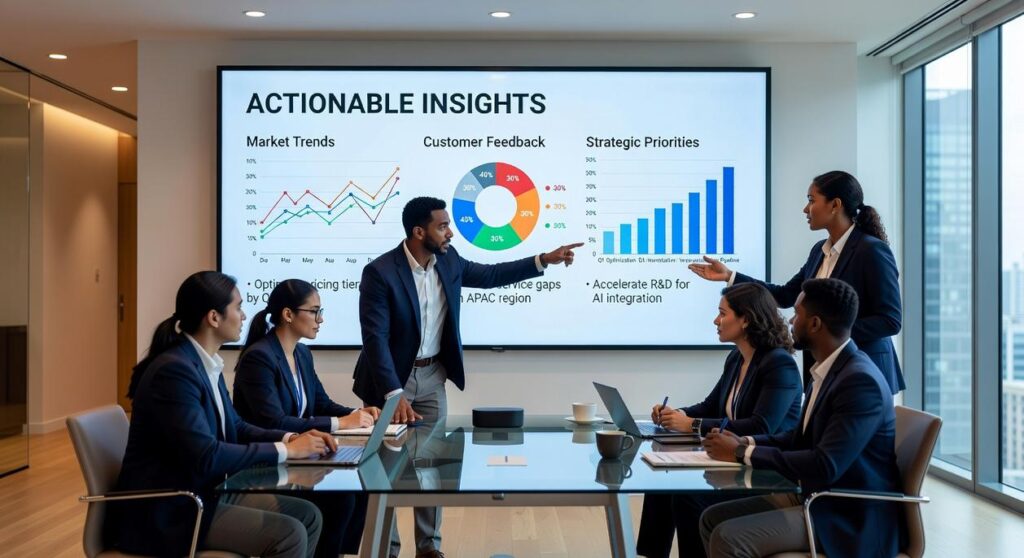
Most teams today have more dashboards than decisions, and that’s exactly the problem.
If you’re here, it’s because you’ve got the data but not the foresight. Historical reports? Sure, they’re useful. But they won’t tell you what’s coming next. Most organizations stall right there, they collect, store, and report on data. Then they stop. Converting it into something predictive or actionable? That’s where things fall apart.
This article changes that.
We’re going beyond retrospectives. Here, you’ll learn how to turn raw data into real foresight through predictive analytics ai—not just the buzzwords, but the actual processes, technologies, and models that make it work.
We built this guide using data science principles that actually work, paired with AI applications companies are already deploying to forecast market shifts, anticipate customer needs, and optimize operations. Nothing here’s theoretical. The tools and techniques you’ll find in these pages? They’re live in production right now, solving real problems.
If you’re ready to move past reports and start seeing around corners, this is where the shift begins.
Defining the leap: from basic analytics to predictive power
Let’s start with a simple truth: knowing what happened isn’t the same as knowing what’s next. That’s the real difference between descriptive analytics and the more future-facing siblings—predictive and prescriptive analytics.
Descriptive analytics tells you, for example, that your smartwatch recorded 3,000 fewer steps last week (guilty as charged). Predictive analytics, powered by machine learning, might forecast that your activity is likely to drop even more as winter sets in. And prescriptive analytics? It suggests you join an indoor spin class. (Yes, the data knows you’re less likely to go for jogs in icy weather.)
So how do you decide which to use? Here’s a quick snapshot:
Descriptive analytics answers the question: what happened? It relies on dashboards and reports to give you hindsight into past events. Predictive analytics, on the other hand, tackles a different challenge, what will happen? That’s where machine learning algorithms and trend analysis come in, offering foresight into future outcomes. Finally, prescriptive analytics asks the most strategic question of all: what should we do? It uses simulations and optimization models to chart your course forward.
Predictive analytics isn’t about crystal-ball accuracy, it’s about generating probabilities you can actually act on. With predictive analytics AI, businesses assess likely outcomes based on past data, then pivot strategies accordingly. Stock traders identify market shifts before the headlines hit. That’s the real game.
Some argue that simulations and modeling aren’t necessary for small operations. Outdated. Forecasting isn’t some Silicon Valley exclusive anymore, mid-tier firms routinely simulate customer behavior to nail inventory planning and marketing budgets because the alternative (guessing) costs them real money. The tools have gotten cheap enough that smaller shops can actually compete, and plenty of them are doing it right now.
Pro tip: Start small. A single machine learning model trained on customer purchase history can reveal more than a dozen static reports ever could.
Bridging that analytics gap means understanding something crucial: moving from descriptive to predictive and prescriptive analytics isn’t just about new technology. You’re rewiring how decisions get made. Faster decisions. Better data behind them. And here’s what actually changes on the ground: you stop second-guessing the numbers, stop waiting for permission to act on what they’re telling you. Agility isn’t some buzzword anymore; it’s survival. The real shift is willingness, not tools.
The forecaster’s toolkit: key algorithms and models
Let’s be honest, predicting the future is hard. But with the right algorithms, you’re not just guessing anymore. You’re working with actual tools that shift the odds in your favor. What belongs in every modern forecaster’s toolkit?
Time-Series Analysis: The Foundation of Trend Projection Forecasting used to be the domain of economists and weathermen. Now? Everyone’s doing it. ARIMA (AutoRegressive Integrated Moving Average) and Prophet, Facebook’s open-source tool, excel at modeling what matters: quarterly sales, energy consumption, the patterns that repeat but never quite the same way twice. Seasonality, trends, anomalies. They all get caught. Prophet won’t predict which Marvel movie tanks at the box office, obviously. But for business data, the kind you actually need to plan around? It’s rock solid.
What’s next? If your business lives and dies by seasonal demand curves, consider pairing these with anomaly detection techniques for real-time alerts.
Linear regression draws a straight line through your data to predict continuous values. Want to forecast revenue based on marketing spend? That’s the classic use case. Logistic regression is different, though, because it doesn’t predict raw numbers, it works with probabilities instead, answering yes-or-no questions: will a customer convert or won’t they? It’s binary thinking.
A common pushback: “Aren’t regressions too simple in the age of AI?”
Short answer—no. They remain foundational and surprisingly effective when the relationship between variables is interpretable. (Pro tip: Always check for multicollinearity—variables stepping on each other’s toes.)
Classification Algorithms: Projecting Categories
Ever wanted to predict if a transaction is shady? Decision Trees and Support Vector Machines (SVMs) are your go-to. These classify data points into buckets (“fraud” vs. “legit”) based on patterns in existing data.
Prediction alert: As datasets grow, expect ensemble methods (like Random Forests) to outshine single-model approaches.
Here’s where it gets genuinely smart. Predictive analytics AI doesn’t require manual model tweaking anymore, it figures out the best algorithm, tunes hyperparameters, and validates accuracy on its own. No more trial-and-error cycles. The system learns what works and adjusts itself, saving you weeks of engineering time that’d otherwise vanish into hyperparameter grids and validation loops.
This isn’t just saving time, it’s unlocking performance gains manual methods often miss.
Still wondering what’s next? As models evolve, expect to see more low-code platforms offering AI-driven forecasting as a plug-and-play solution. Because soon, not using AI might just be the real risk.
(And yes, your competition is already on it.)
Real-world applications: turning projections into action

Let’s be clear about this: projections aren’t just guesswork dressed up in a lab coat. Done well, they’re actionable insights grounded in actual data. The smartest organizations? They’re already using them.
Operational Efficiency: Predictive Maintenance
Take aviation, for example. Jet engine manufacturers like Rolls-Royce use sensor data to detect patterns in engine wear. Their models project component failure with remarkable accuracy—enabling maintenance teams to act before breakdowns happen. According to Deloitte, predictive maintenance can reduce maintenance costs by 20% and unplanned outages by up to 50%.
Retail giants like Walmart dig through years of point-of-sale data, weather patterns, and social media sentiment to predict what customers will actually buy. Get the forecast right, you sidestep overstocking. Get it wrong? You’re stuck with empty shelves when demand peaks. McKinsey found that companies using AI-powered demand forecasting cut lost sales from inventory problems by as much as 65%. That’s a staggering number. And it points to something simpler: the gap between prediction and reality is where competitive advantage actually lives.
User Experience: Smart Device Integration
Connected devices have quietly become mind readers (the helpful kind). A smart thermostat, for instance, doesn’t just adjust the heat—it learns your schedule and predicts your needs. Streaming platforms take this further: Netflix’s recommendation engine, powered by predictive analytics ai, drives over 80% of viewer activity. It learns, serves, and keeps you watching (yes, they know you’ll binge).
Financial Markets: Algorithmic Trading
And in the high-stakes world of financial markets, milliseconds matter. Hedge funds rely on algorithmic trading models to analyze massive volumes of data in real time. These models identify price inefficiencies and execute trades within fractions of a second—so fast, a human couldn’t keep up on their best day.
Pro tip: The magic isn’t just in having the data—it’s in knowing how to ask the right questions with it.
The human factor: ensuring data quality and avoiding pitfalls
You could have the most sophisticated algorithm in the world, but garbage data in means garbage results out. That’s the whole point of “Garbage In, Garbage Out.” It’s simple. Before you can trust any insights, your data needs cleaning, scrubbing, validation, because the basics actually matter in ways people forget to care about until their entire analysis falls apart. Like cooking: use stale ingredients and you’ll taste it in the final dish.
Some argue modern models can “learn through the noise,” but that’s only half the story. Predictive analytics AI can crunch numbers fast, sure. Yet it’s still vulnerable to historical biases baked into the training data. Hiring AI trained on decades of skewed data? It’ll just repeat those same patterns, filtering out qualified candidates who don’t fit the mold, unintentionally or not. That’s the real risk.
Then there’s interpretation. A model might flag churn risk at 85%, but what does that actually mean for your strategy? You need human insight to make sense of the output, ask the hard follow-up questions, and figure out whether you should act on it.
Pro tip: Set up regular performance benchmarks. A model you trust today may drift tomorrow without warning.
Bottom line? Keep refining. Monitor, retrain, repeat. Data may drive the system, but humans steer the wheel.
I built this guide because too many teams are sitting on mountains of raw data without knowing what to do with it.
The real problem isn’t access, it’s activation. Data only becomes valuable when transformed through the right analytical techniques into real, forward-looking insights.
You’ve got a clear framework now. Predictive analytics AI transforms static information into action, time-series models, machine learning algorithms, solid data quality. None of it’s theoretical anymore. These tools don’t sit in whitepapers or conference talks. They’re in production systems, firing every day, solving real problems for teams that know how to use them.
You came here to figure out how organizations use analytics to see around the corner. That clarity is now yours.
Pick one business question that’s been nagging you. What’s coming next in your market, your customer behavior, your operations? Look around, and you’ll probably find the data you need is already sitting somewhere in your systems, waiting. That focused question becomes your entry point into predictive analytics AI. Start there. It’s simpler than you think.
Build a proactive data future, starting now
Still relying on guesswork to make business decisions? You don’t have to.
Predictive analytics AI lets you forecast with real confidence. Getting started? It doesn’t require months of setup or a team of PhDs. We’re the #1 resource for organizations ready to turn raw data into actual foresight, not just dashboards collecting dust.
Start with one question. One dataset. One move toward a smarter strategy. Call us or explore our tools to take the next step.

 Della Lovellerds writes the kind of smart device integration tactics content that people actually send to each other. Not because it's flashy or controversial, but because it's the sort of thing where you read it and immediately think of three people who need to see it. Della has a talent for identifying the questions that a lot of people have but haven't quite figured out how to articulate yet — and then answering them properly.
They covers a lot of ground: Smart Device Integration Tactics, Innovation Alerts, Tech Optimization Hacks, and plenty of adjacent territory that doesn't always get treated with the same seriousness. The consistency across all of it is a certain kind of respect for the reader. Della doesn't assume people are stupid, and they doesn't assume they know everything either. They writes for someone who is genuinely trying to figure something out — because that's usually who's actually reading. That assumption shapes everything from how they structures an explanation to how much background they includes before getting to the point.
Beyond the practical stuff, there's something in Della's writing that reflects a real investment in the subject — not performed enthusiasm, but the kind of sustained interest that produces insight over time. They has been paying attention to smart device integration tactics long enough that they notices things a more casual observer would miss. That depth shows up in the work in ways that are hard to fake.
Della Lovellerds writes the kind of smart device integration tactics content that people actually send to each other. Not because it's flashy or controversial, but because it's the sort of thing where you read it and immediately think of three people who need to see it. Della has a talent for identifying the questions that a lot of people have but haven't quite figured out how to articulate yet — and then answering them properly.
They covers a lot of ground: Smart Device Integration Tactics, Innovation Alerts, Tech Optimization Hacks, and plenty of adjacent territory that doesn't always get treated with the same seriousness. The consistency across all of it is a certain kind of respect for the reader. Della doesn't assume people are stupid, and they doesn't assume they know everything either. They writes for someone who is genuinely trying to figure something out — because that's usually who's actually reading. That assumption shapes everything from how they structures an explanation to how much background they includes before getting to the point.
Beyond the practical stuff, there's something in Della's writing that reflects a real investment in the subject — not performed enthusiasm, but the kind of sustained interest that produces insight over time. They has been paying attention to smart device integration tactics long enough that they notices things a more casual observer would miss. That depth shows up in the work in ways that are hard to fake.